


More and more companies are being asked by their customers, investors or clients for the carbon footprint of their products and not just that of the company as a whole.
This is what we call the Product Carbon Footprint, the PCF, or the product carbon footprint. The PCF measures the greenhouse gas emissions generated by a product throughout its entire life cycle.
Long reserved for large industrial companies, the PCF is now a strategic tool for an increasing number of organizations. The pressure is both regulatory (CSRD, MACF...) and commercial, with buyers now integrating the PCF into their supplier selection criteria.
In this article, we explain what the PCF is, how to calculate it, how it differs from the carbon footprint and why it has become a must for any company wishing to seriously drive its decarbonization strategy.
1. What is the Product Carbon Footprint?
The Product Carbon Footprint (PCF) is a method for measuring greenhouse gas (GHG) emissions generated by a product or service throughout its entire life cycle: from the extraction of raw materials to its end of life, including its manufacture or use.
The results are expressed in kilograms of CO₂ equivalent (kg CO₂e), which provides a clear and quantified view of the climate impact of a product and identifies the most emitting steps to guide reduction efforts.
- The reference standard: ISO 14067
ISO 14067:2018 is the international standard that specifies the requirements and guidelines for calculating and presenting a Product Carbon Footprint.
It allows companies to follow a clear, rigorous and uniform methodology for their PCF and thus ensure their compliance.
- What are the differences between a PCF and a complete LCA?
The PCF differs from a Life Cycle Assessment (LCA) by its deliberately limited scope: it only focuses on the "climate change" indicator by measuring only the emissions of gases related to the product.
Whereas a multi-criteria LCA also analyzes the impact on biodiversity, water eutrophication, resource depletion or even terrestrial and freshwater acidification.
The PCF thus makes it possible to focus on the carbon footprint and thus very clearly identify the steps in the product's life cycle that are the most emitting. It is a major tool for companies wishing to focus their decarbonization efforts where the levers are the most important and thus give themselves every chance of massively and more quickly reducing their emissions.
- What are the differences between a PCF and a carbon footprint?
The PCF and the carbon footprint share the fact of measuring in both cases the emissions of greenhouse gases.
On the other hand, the carbon footprint analyzes the GHG emissions of the company and its value chain and not of a product or service. All inputs are taken into account, the impact of all products manufactured by the company but also the movements of employees or the energy used to heat the premises.
While the PCF focuses solely on the data of the product(s) studied.
The PCF allows you to zoom in on the precise impact of a system studied where the carbon footprint allows you to have an overall view of the emissions related to the company's activity.
But PCF and carbon footprint do not oppose each other, they are even complementary. We will come back to this a little later in this article.
2. Why do a Product Carbon Footprint?
- Responding to the requirements of your partners and clients
Today, large companies no longer limit themselves to greening their own perimeter (Scope 1 and 2). To achieve their neutrality objectives, they are tackling their Scope 3: the emissions of their value chain.
As a result, large accounts are becoming increasingly demanding and require their suppliers to provide precise and verifiable carbon data.
Mastering your PCF is to guarantee your place in these supply chains and turn a compliance constraint into a major commercial advantage.
- Anticipating regulatory and financial pressure
The European legislative framework is tightening. The PCF becomes an essential tool to respond to two major regulations:
- The CSRD (Corporate Sustainability Reporting Directive): it requires large companies to report their environmental impacts in detail.
- The CBAM (Carbon Border Adjustment Mechanism): for the sectors concerned, calculating the carbon content of products is now an obligation to cross European borders.
Meanwhile, investors are increasingly integrating ESG criteria into their decisions. A robust PCF is a guarantee of transparency that reassures about the company's ability to manage its long-term climate risks.
- Refine and drive your decarbonization strategy
The PCF is the indispensable complement to the company's Carbon Footprint. Where the Carbon Footprint offers a macroscopic vision, the PCF allows:
- Identifying the "Hotspots": it allows isolating the most emitting steps in the life cycle.
- Being more precise: by injecting real product data into your overall Carbon Footprint, you gain in precision and move away from monetary ratios often too imprecise
- Prioritizing: you no longer work blindly, you focus your reduction efforts where the impact is strongest.
- Engage in a genuine eco-design approach
As highlighted by the ADEME, eco-design aims to reduce the impacts of a product from its inception. The PCF (often based on the PEF - Product Environmental Footprint methodology) is the first building block of this approach. It allows:
- Comparing scenarios: testing the impact of an alternative material or a change of supplier before production.
- Benchmarking: comparing your products internally or against competitors to aim for environmental excellence.
- Communicate transparently and avoid greenwashing
At a time of environmental labeling (already effective in textiles since October 2025 and soon extended to food, furniture or cosmetics), transparency is a reputation obligation.
Relying on a PCF compliant with standards allows making robust environmental claims. It is the only way to prove the performance of your products to consumers and avoid accusations of greenwashing, while valuing your reduction efforts in a factual manner.
3. How to calculate a Product Carbon Footprint (PCF)?
As for an LCA, you need to follow 4 main steps.
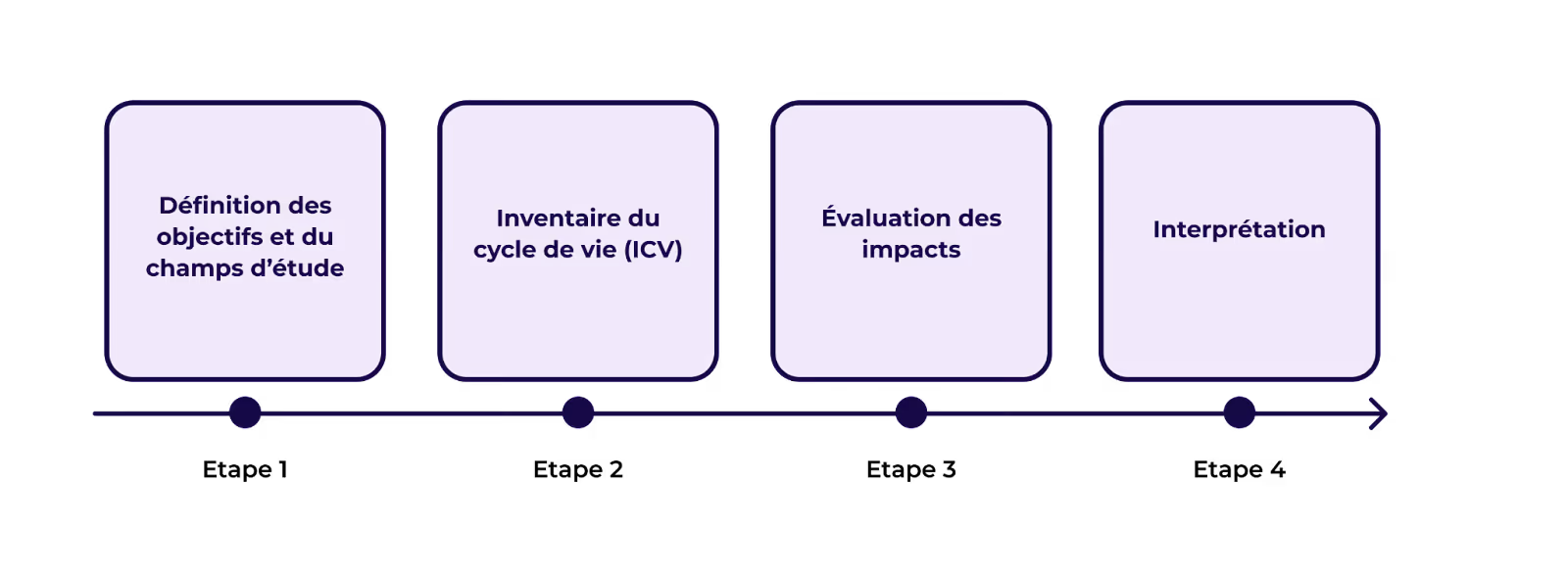
Definition of objectives and scope of the study
- Study objective
This is the reason why the company decides to carry out an LCA: eco-design, comparison of several products or services, comparison with competitors...
- The scope of the study
This is when the main characteristics and assumptions chosen are specified.
- Is a cradle-to-grave PCF being carried out, "from cradle to grave" therefore covering all stages of the product's life cycle, or a cradle-to-gate PCF, "from cradle to gate" which excludes the stages of product use and end-of-life? If it is a cradle-to-gate PCF, the company must explicitly mention this in its inventory report.
- What is the functional unit of the product or service on which the Product Carbon Footprint is based? This is fundamental in defining the scope of the study. The functional unit is the primary function, the service provided by the system studied.
Some examples of functional units: number of times a garment is worn, driving 15,000 km/year and for 20 years for a car, etc...
- Methodological limitations.
Life Cycle Inventory
This is the most time-consuming step, corresponding to data collection. It involves tracing all the flows of the product studied: the incoming and outgoing flows.
All data that can be directly attributed to the product life cycle must be collected based on the study scope definition and the flow mapping that will be developed.
During this step, companies must pay attention to the quality of the data collected. Several types of data are available: primary data, secondary data, financial data.
Companies must be able to assess the quality of the data in order to select those that are the most representative of the actual emissions of the product, based on precise indicators (temporal, geographical...).
Evaluating the quality of the data then allows:
- improve the quality of the current inventory and the next ones by identifying the data of lower quality. The company can thus identify which data it should focus on to improve their quality.
- document the inventory process and thus provide information if an audit phase is conducted.
- provide proof to its stakeholders of the quality of the data used during the inventory
Impact Assessment
For the results of a PCF, the unit used is the CO2 equivalent (CO2e).
At this point, it is a matter of converting the collected data into CO2 equivalent. Companies must apply a global warming potential (GWP) factor over 100 years.
Thus, for all greenhouse gases that will appear in the life cycle inventory, they will need to be converted into CO2e by associating them with a characterization factor. For methane, for example, we know that 1 tonne of methane is equivalent to 28 tonnes of CO2. We will therefore multiply the methane flows by this factor of 28. Another example, for nitrous oxide, its global warming potential is 298 times higher than CO2. We therefore associate it with a factor of 298.
Interpretation of results and reporting
This is when we move from accounting to action.
This phase is used to verify the robustness of the study, in particular:
- by identifying which steps of the life cycle (raw materials, transport, manufacturing, end of life) contribute the most to the total footprint.
- by conducting an uncertainty analysis: it is necessary to explain the margin of error related to the databases used
If you decide to communicate a reporting of the results of the Product Carbon Footprint, the report must include in particular:
- the Scope: "Cradle-to-Grave" (cradle to grave) or "Cradle-to-Gate" (cradle to gate).
- exclusions: what has not been counted in the product carbon footprint?
- methodological choices
This last step is crucial both to communicate transparently about your approach and to identify what could be called opportunities to reduce greenhouse gas emissions, i.e. the most important reduction levers.
FAQ
1. Does the PCF replace the carbon footprint of my company?
No, they are complementary. The Carbon Footprint provides an overall view of the climate health of your organization (offices, travel, vehicle fleet, etc.), while the PCF is a magnifying glass on a specific product. Carrying out a PCF allows you to refine your overall Carbon Footprint by replacing monetary estimates with real and precise data related to your manufacturing cycle.
2. What is the difference between a "Cradle-to-Gate" and "Cradle-to-Grave" calculation?
It all depends on the use of the report:
- Cradle-to-Gate (from cradle to gate): stops when the product leaves your factory.
- Cradle-to-Grave (from cradle to grave): includes use by the end consumer and waste treatment.
3. Is it mandatory to follow the ISO 14067 standard?
Although this is not a strict legal obligation for all companies, following the ISO 14067 standard is recommended. It guarantees to your investors and customers that your results are comparable, transparent and based on a scientifically recognized methodology worldwide.
4. Why prefer the PCF rather than a complete LCA?
The PCF is faster and less costly to implement as it focuses on a single indicator: climate change. It is the ideal tool if your strategic priority is decarbonization. However, if you wish to communicate on other environmental aspects (water consumption, ocean protection, etc.), you will then need to evolve towards a multi-criteria Life Cycle Assessment (LCA).
Mission Décarbonation
Don't miss the latest climate news and stay ahead of regulatory changes


.avif)


.avif)

Les commentaires